


Our biopharmaceutical services include the testing, characterization and evaluation of various molecules, such as proteins, antibodies and peptides. We meet the challenges of identity, purity, quality, safety and efficacy.
Laboratory characterization, analysis and testing of biotherapeutics and biologics
Biotherapeutics and biologics are innovative and complex solutions that require special attention at every stage of their development. Whether characterizing small molecules (ex : nitrosamines) or large molecules, our laboratory is equipped with the latest analytical technologies to meet the most demanding quality and safety requirements.
Characterization of large molecules :
We offer advanced expertise in the characterization of biotherapeutics, especially recombinant proteins. Our proven methods ensure an in-depth understanding of their structure, stability and efficacy.
Thanks to our know-how and state-of-the-art tools, we can support you in the success of your projects by guaranteeing the quality, safety and efficacy of your biotherapeutic products.
FILAB supports you in assessing the test procedures and acceptance criteria for all your biotherapeutics (mAb, proteins, peptides) - ICH Q6B
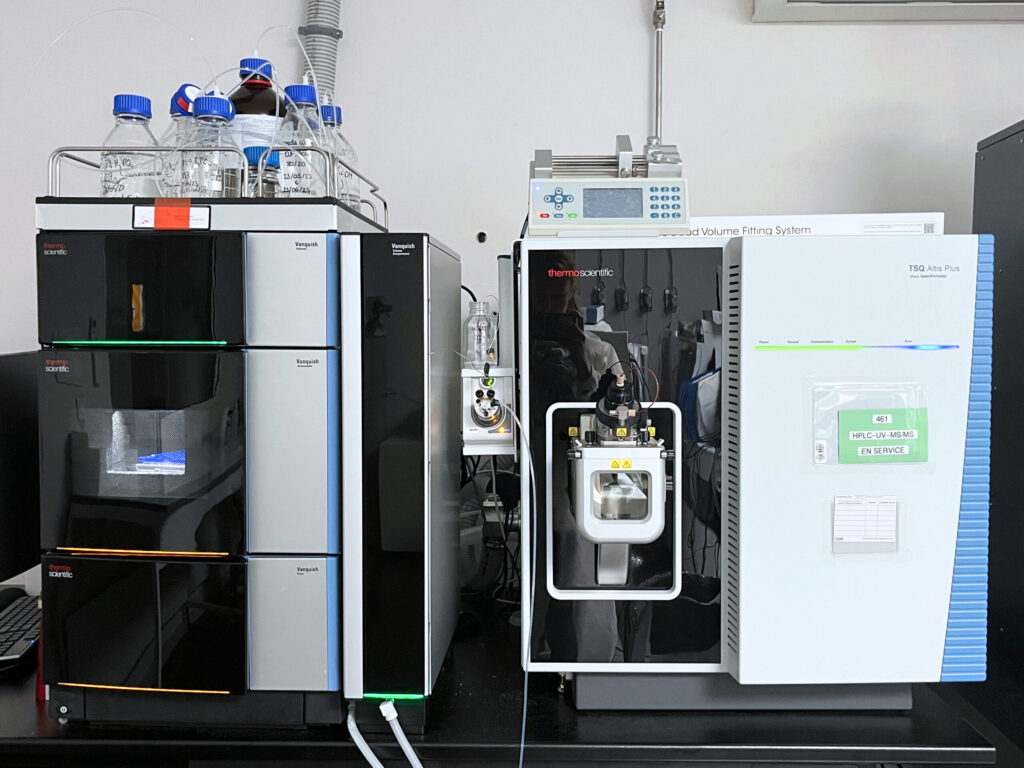
Thanks to our expertise in LC-MS/MS, we can provide accurate and reliable data for characterising your biomolecules. Our biopharmaceutical analyses focus specifically on the structure and composition of monoclonal antibodies, recombinant hormones, therapeutic enzymes and proteins, enabling us to detect any post-translational modifications, impurities or degradation.
Protein analysis is used to assess the stability, purity and integrity of these biomolecules, ensuring their compliance with regulatory standards and their efficacy in biopharmaceutical applications.
Structural characterization and confirmation
Carbohydrate structure : monosaccharide composition, glycosylation sites of polypertide chain
Reduced forms (HC, LC, Fab, FC)
Thermal stability
Sulfhydryl group(s) and disulfide bridges
Monosaccharide analysis by fluorometry and HPLC
Identification and quantification of PTMs
Physicochemical properties
Thanks to these methods, we provide robust, detailed data on the size, mass and optical properties of biomolecules, essential for their development, validation and quality control.
Molecular weight or size (intact mass) by LC-MS ans SEC-Triple detection
Liquid chromatographic patterns (charge variants by IEX-UV)
Solubility: critical concentration and stability in solution
Chromatographic profiles: characteristic liquid fingerprint by IEX or SEC
Spectroscopic profiles (UV and visible absorption, characterization and identification)
Isoelectric point (pI) measurement: net protein charge
Impurities identification
Detecting and characterizing impurities in biopharmaceutical products is essential to ensure their safety, efficacy and compliance with regulatory standards such as ICH Q6B.
Truncated forms by LC-MS
Aggregates by SEC-Triple detection
Process related impurities (analysis of culture cell media ; amino acids, vitamins, sccharides)
Quantitative analysis of residual DNA
Extractables & Leachables (E&L studies)
Post-translational modifications (PTMs) by LC-MS/MS (deamidated, oxidization, glycosylation, other PTMs)
Process related impurities (elemental impurities identification -USP 233 - ICH Q3D guideline)
HCP (Host Cell Protein) detection and quantification
Analysis of solvent and cell culture residues
To detect process-related impurities, we offer specific tests such as the quantification of elemental impurities in accordance with USP 233 and ICH Q3D, as well as extract and leachate (E&L) analyses. We also analyze cell culture media (amino acids, vitamins, saccharides) to ensure the quality of bioproduction processes.
Thanks to our state-of-the-art analytical tools, we can guarantee accurate data in line with industry standards, ensuring the quality and safety of your biopharmaceutical products.
FAQ
Peptide mapping is a key technique for characterizing biotherapeutics. It involves breaking down proteins into peptides to analyze their amino acid sequence. Used throughout drug development, this method guarantees protein integrity and purity, detecting modifications and impurities using advanced technologies such as LC-MS/MS.
ICH Q6B is an international guideline that establishes uniform specifications for the quality of biotechnological and biological products. This document provides specific principles for the characterization, purity, identity, quantity and potency of proteins, polypeptides and their derivatives. It also applies to the control of impurities, contaminants and other critical process parameters. The aim of ICH Q6B is to ensure that new products meet the quality standards required for marketing, by ensuring the safety and efficacy of biological treatments.